

Sometimes the problem isn't missing software
I fix how work flows through your business first — then build only what actually needs to exist.
Common signs you need help
- You bought software to fix a problem that was really a process problem
- Handoffs between teams lose information every week
- Everyone's busy but throughput hasn't improved
Who this is for
This is for businesses that already bought the software and still have the problem. Everyone is busy, throughput has not improved, and handoffs between teams lose information every week. Often there has been a platform migration in the last two years that was supposed to fix it. If you cannot draw how work moves from enquiry to delivery on one page without arguing about it, start here rather than with another tool.
Where this applies
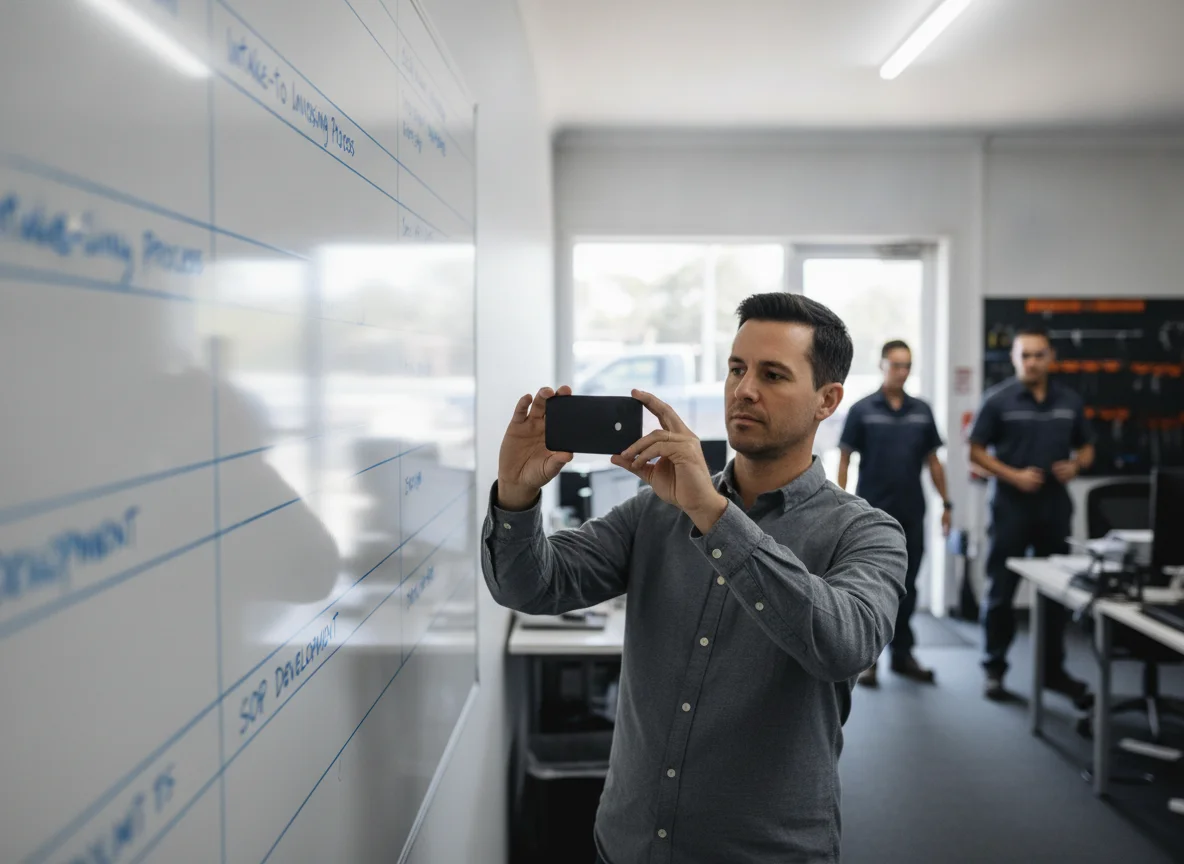
Process maps on a wall don't change what happens at 4pm on a Friday — I redesign how work moves, then ship the systems to match.
Operational redesign from intake to invoicing.
What the assessment covers
Map current-state workflows and failure points
Separate "fix the process" from "build a tool"
Start with the one process that leaks most, fixed at a fixed price
What I build
SOP packs, workflow redesign, lightweight tooling where it pays off
The deliverable is a current-state map of how work actually flows — not how the org chart says it should — with every wait state, rework loop, and undocumented handoff marked. From that I produce SOPs for the steps that need consistency, a decision on which system owns which data, and a shortlist of the few places where a small piece of tooling genuinely pays off. Sometimes the outcome is one automation and a rewritten checklist.
Buying another platform against redesigning the flow
| Another platform | Operational redesign | |
|---|---|---|
| What it assumes | Your process is sound and the tool is the gap | The process is the gap, and tooling follows it |
| Typical result when wrong | Migration cost, same handoffs, lower morale | Fewer handoffs, sometimes no new software at all |
| What you keep | A licence and a configuration | A current-state map, SOPs, and a ranked roadmap |
| Commitment | Multi-year contract | Fixed-price engagement, build quoted separately |
What it assumes
- Another platform:
- Your process is sound and the tool is the gap
- Operational redesign:
- The process is the gap, and tooling follows it
Typical result when wrong
- Another platform:
- Migration cost, same handoffs, lower morale
- Operational redesign:
- Fewer handoffs, sometimes no new software at all
What you keep
- Another platform:
- A licence and a configuration
- Operational redesign:
- A current-state map, SOPs, and a ranked roadmap
Commitment
- Another platform:
- Multi-year contract
- Operational redesign:
- Fixed-price engagement, build quoted separately
What it costs and how I scope it
This work is deliberately build-oriented even when the answer turns out to be process rather than software. One process starts with the free 30-minute call and a working sample, like any other fix. Redesigning how work moves across several teams is a bigger project: I scope it with a paid Opportunities Report first, priced up front, and the roadmap is written so you can act on it with or without me. Where a build is warranted I quote it separately, so you never have to commit to a build to get the analysis.
Every fix starts with a free 30-minute call and a free working sample, so you know the fixed price before work begins. Bigger projects get a paid Opportunities Report first.
When this is the wrong fix
Redesign is the wrong purchase if the process is fine and the tools are simply broken or missing — go straight to the build. It is also wrong if leadership is not prepared to change how work is allocated, because a map that nobody acts on is the expensive slide deck I exist to avoid. I would rather scope a smaller, real fix than run an analysis that ends in a shared drive.
Related reading
FAQ
- Is this just consulting decks?
- No. Every engagement is build-oriented. If the answer is process-only, you still get actionable deliverables — not a 80-slide PDF.
Got a process you've outgrown?
Show me on a free 30-minute call. You'll see a working sample of the fix within two business days, before you pay a cent.
Book my free 30-minute call